.png)

The Psychology of Red and Green: How Colors Move Money
You open your investment app on a Monday morning.
Your eyes scan the screen — half your dashboard glows green, and you smile. A good start to the week.
A few days later, it’s all red, and suddenly the same investments that made you confident now make you nervous.
What changed? The numbers? Barely.
Your emotions? Completely.
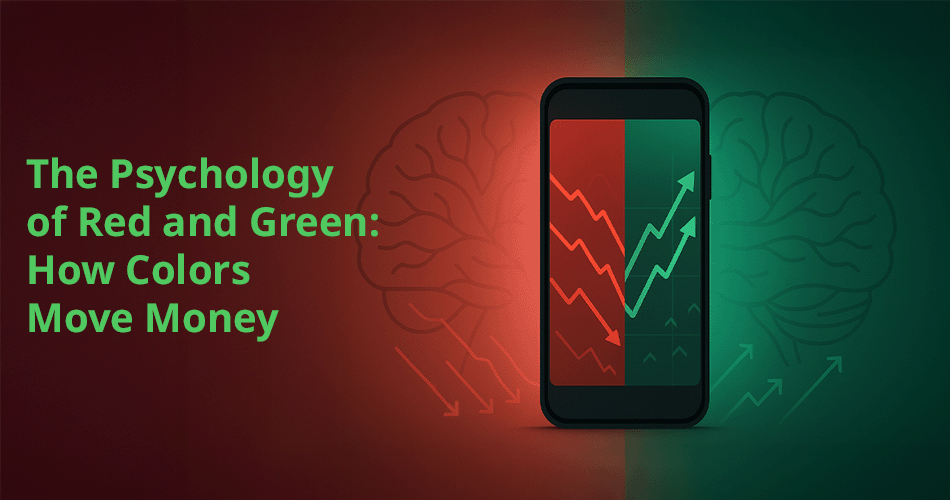
Welcome to the invisible world of color psychology in investing — where design and emotion quietly influence every financial move, from individual stocks to diversified investment products such as Mutual Funds.
Because sometimes, it’s not your portfolio that changes your mood — it’s the colors that speak before logic does.
Why Colors Speak Louder Than Numbers
Before we learned to read, we learned to see.
Before we processed logic, we reacted to color.
Colors carry emotional meaning hardwired into our biology.
Red meant danger, fire, or stop.
Green meant safety, life, and go.
Those same instincts still shape how we react to information today — including money.
In finance, these colors aren’t random.
They’re chosen because they evoke specific emotional responses.
Red activates alertness and caution.
Green evokes comfort and confidence.
So when an investment or Mutual Fund dashboard flashes green, investors often feel reassured. When it turns red, they may feel uneasy — even if nothing fundamental has changed.
In other words, investors don’t just see their portfolio — they feel it.
Red: The Color That Makes Investors Panic
Red has always been the color of urgency — a stoplight, a warning, a sign that says “pay attention.”
It’s no surprise that it’s used to represent loss in financial charts.
When your Mutual Fund NAV or portfolio graph turns red, your brain doesn’t interpret it as “short-term volatility.” It interprets it as danger.
This reaction comes from a primitive part of the brain called the amygdala, which controls fear and stress responses.
It releases cortisol, the stress hormone, making you anxious and alert.
That’s why even experienced investors feel tense when they see a sea of red. It’s biological, not rational.
The challenge is that this instinct was designed for survival, not for investing.
In the wild, “run” was the right reaction to danger.
In investing, reacting too quickly can sometimes mean exiting just before recovery.
For instance, during the 2020 correction, many investors paused their SIPs out of concern, while others continued based on their long-term goals.
Those who stayed invested participated in the subsequent market recovery — illustrating how consistency can sometimes support long‑term objectives.
Red made some investors retreat — but others who looked past the color stayed aligned with their goals.
Lesson: Red doesn’t necessarily indicate that action is required; it often reflects normal market movement.
Green: The Color That Creates Confidence (and Sometimes, Overconfidence)
If red makes you cautious, green makes you hopeful.
Green represents life, stability, and prosperity. It’s the color of nature — and of money itself.
When you see your investments in green, your brain releases dopamine, the chemical associated with reward.
This creates a loop of pleasure and optimism.
You open your app more often.
You feel smarter.
You believe you can predict the next winner.
That’s where overconfidence can sneak in.
Green markets may make people feel more aggressive, skip due diligence, or chase trending funds or stocks.
But markets are like seasons — green doesn’t last forever.
In Mutual Funds, this behavior can show up as performance-chasing — frequently switching between funds based on short-term trends.
It feels smart in the moment but can lead to disappointment when trends reverse.
Lesson: Green may remind investors that long-term goals often require patience, but markets can still move both ways.
The Hidden Design Psychology Behind Apps
Here’s something most investors never notice — trading and investment apps are built to make you react emotionally.
Why? Because emotion drives engagement, and engagement drives activity.
When you open an app and see a red‑green dashboard, the design isn’t just informative — it’s influential.
Every tap, animation, and notification is created to make you feel something:
These are UI (User Interface) triggers, designed using principles of behavioral science.
The more emotionally charged you feel, the more you interact.
But frequent reactions can sometimes reduce long-term discipline.
Studies show that investors who stay goal-focused, automate their SIPs, and avoid checking their portfolios too often often demonstrate more consistent investing behavior over time.
In other words, discipline — not dopamine — supports long-term investing behavior.
The Emotion Loop: Red, Green, Repeat
Here’s the emotional loop many investors fall into:
You open the app. You see red. You feel stress.
You scroll further, spot green. You feel relief.
You check again later. It’s red again. Anxiety returns.
You didn’t make a transaction.
You didn’t change your plan.
Yet your emotions rode a full rollercoaster — all because of color.
This constant switching between fear and comfort drains focus and fuels short-term thinking.
It can tempt investors to act — pausing SIPs, switching funds, or redeeming early — even when long-term goals remain unchanged.
The irony?
Most of these actions, driven by emotion, can disrupt long-term compounding.
A portfolio guided by colors often misses the bigger picture:
Long-term wealth creation usually depends less on reacting to red and green, and more on staying consistent through both.
Mutual Funds and the Color Trap
Mutual Funds are designed to encourage discipline and systematic investing.
They work best when investors stay patient and goal-focused.
Yet many investors treat their Mutual Fund portfolios like stocks — checking daily performance, worrying over dips, or feeling euphoric after small gains.
That’s the color trap.
When a dashboard shows a Mutual Fund portfolio in red, it’s easy to think, “I should switch.” But switching based on short-term dips may mean exiting during temporary declines.
Similarly, when a fund’s chart turns green and rising, investors may feel tempted to invest more impulsively, overlooking their asset allocation.
Disciplined investors take a different view.
They see red as a signal to review — not to react.
They see green as a reminder of progress — not perfection.
Over time, this emotional discipline allows Mutual Funds to serve their intended purpose — supporting long-term wealth creation through market cycles.
How to Stay Emotionally Balanced
You can’t change the colors on your screen — but you can change how you respond to them.
Here are five simple ways investors can stay calm through the red‑green cycle:
SIPs are designed to encourage disciplined investing and reduce the tendency to react to short-term movements.
Since most financial goals are long-term, checking NAVs every day can amplify short-term emotions.
Instead of focusing on whether your screen shows red or green, reflect on whether you’re still aligned with your financial objectives.
A financial professional can help provide perspective and help investors stay aligned with their goals.
Remaining invested through both red and green phases often supports steadier long-term progress than chasing short-term gains.
A Case Study of a Different Kind
Let’s revisit Isha — a young professional who started SIPs three years ago.
When markets fell in 2022, her app showed all her equity Mutual Funds in red. She panicked and almost stopped her SIPs. But her financial professional reminded her that market declines are temporary, while her goals are long-term.
She decided to stay invested.
When markets recovered the following year, she observed how staying consistent through volatility helped her stay aligned with her long-term goals.
What she learned: “The market changes colors. My commitment shouldn’t.”
That moment helped her understand the difference between reacting emotionally and staying disciplined as an investor.
Final Reflection: Beyond Red and Green
Red and green are just colours — but they stir more emotions than we realize.
They make us feel fear and hope, loss and victory — sometimes all in the same day.
Yet investing, especially through Mutual Funds, isn’t about reacting to colors; it’s about finding balance between them.
Red can serve as a reminder that volatility is often part of long-term growth.
Green may remind investors that sustained progress usually comes from consistency.
Disciplined investors focus on goals rather than colors.
Because in the end, the color that truly matters is the calm of staying invested.
This content is for investor education only. I/we act as an AMFI‑registered Mutual Fund Distributor and do not provide investment advice. This blog should not be treated as investment advice or a recommendation. Mutual Fund investments are subject to market risks. Read all scheme-related documents carefully.
Disclaimer: Financial Data is highly sensitive Information & we guarantee complete confidentiality about it.

B 305 HulasBasti Gardens CHSL
Mahavirnagar, Kandivali West,
Mumbai, Maharashtra, India - 400067
+91 9819824260
.png)
.png)
.png)
.png)
Copyright © Anjgel Wealth. All rights reserved.